


Safeguarding Living Heritage Capacity-Building in Finland
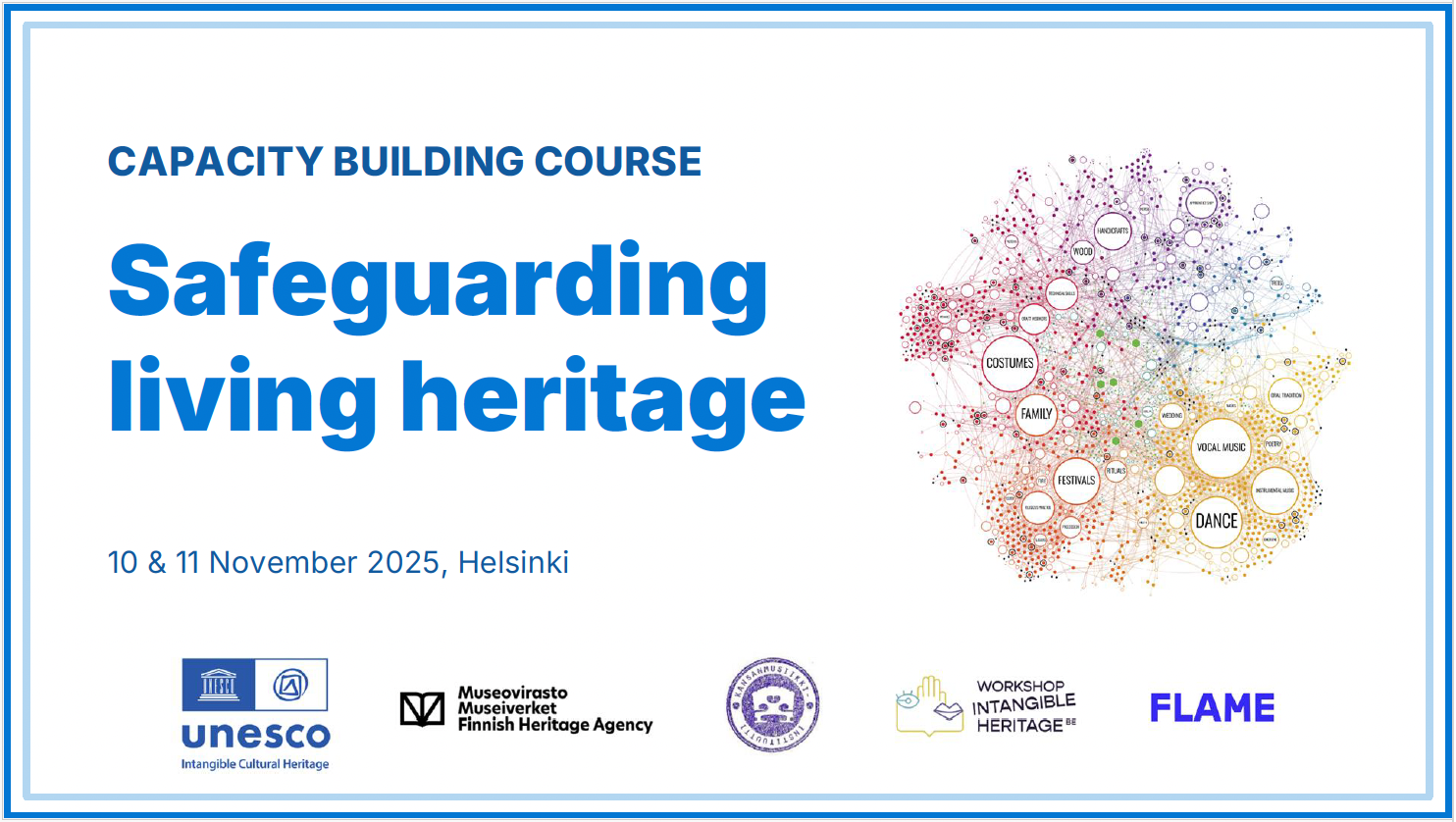
A capacity-building course exploring practical approaches to safeguarding living heritage, developing safeguarding plans and supporting the communities who practise and transmit it.
About the resource
How can heritage professionals, mediators and institutions effectively support the safeguarding of living heritage without taking ownership away from the communities concerned?
The Safeguarding Living Heritage capacity-building course addressed this question through a combination of online sessions, in-person workshops, practical exercises and peer learning. Organised on 3–4 November 2025 online and on 10–11 November 2025 in Helsinki, Finland, the course brought together approaches to safeguarding under the UNESCO 2003 Convention for the Safeguarding of the Intangible Cultural Heritage.
The course aimed to deepen participants’ understanding of the Convention, strengthen their skills in developing effective safeguarding plans, and encourage networking among different actors working with intangible cultural heritage.
From understanding to action
A central focus of the course was the role of mediators, facilitators and heritage professionals. Rather than acting as practitioners or deciding on behalf of communities, their role is to help create the conditions in which living heritage can continue to be practised, shared and transmitted.
Participants explored how living heritage connects with their own organisations and working contexts, identified the stakeholders involved in particular practices, and reflected on the values and meanings that heritage holds for the communities concerned.
The course also introduced UNESCO’s seven-step approach to developing safeguarding plans:
- Identifying the living heritage to be safeguarded and the communities, groups and individuals concerned.
- Understanding its social functions and value.
- Identifying risks and threats and proposing appropriate safeguarding activities.
- Defining objectives and expected results.
- Determining the activities required.
- Identifying resources and strategies for mobilising them.
- Monitoring and evaluating implementation.
Practical tools and collaborative learning
The course combined presentations with participatory exercises and group work. Activities included mapping an organisation’s relationship with living heritage, identifying stakeholders, reflecting on the strengths and challenges affecting a heritage practice, and exploring possible safeguarding initiatives.
A role-play exercise, The Transhumance Dilemma, invited participants to negotiate a safeguarding plan in a fictional setting where traditional pastoralism, biodiversity conservation, economic development and tourism raised competing concerns. It offered a way to explore how different stakeholders can work towards shared solutions while recognising their different interests and responsibilities.
The accompanying worksheets provide structured ways to explore living heritage in an organisation’s work, identify the communities and stakeholders concerned, assess the situation of a practice, and develop safeguarding plans collaboratively.
An important principle runs throughout these materials: safeguarding is not simply a list of activities. It is a coordinated approach intended to support the continued viability of living heritage, with the communities concerned playing the primary role in decisions about their heritage.


Who is this resource for?
This resource is intended for:
- Heritage professionals and cultural institutions
- Mediators and facilitators
- Government officials and policymakers
- Museums, archives and NGOs
- Educators, trainers and researchers
- Anyone interested in supporting community-led safeguarding of living heritage
Explore the materials
The course materials include presentations on safeguarding living heritage, the implementation of the UNESCO 2003 Convention in Finland, recent developments in the field, practical worksheets and a role-play exercise for collaborative safeguarding planning.
Together, they offer inspiration and practical starting points for professionals and organisations seeking to strengthen their work with living heritage and the communities who keep it alive.
Course dates: 3–4 November 2025 (online); 10–11 November 2025 (Helsinki, Finland)
Organised in the context of: UNESCO’s 2003 Convention Capacity-Building Programme
Materials: Presentations, practical worksheets and role-play exercise