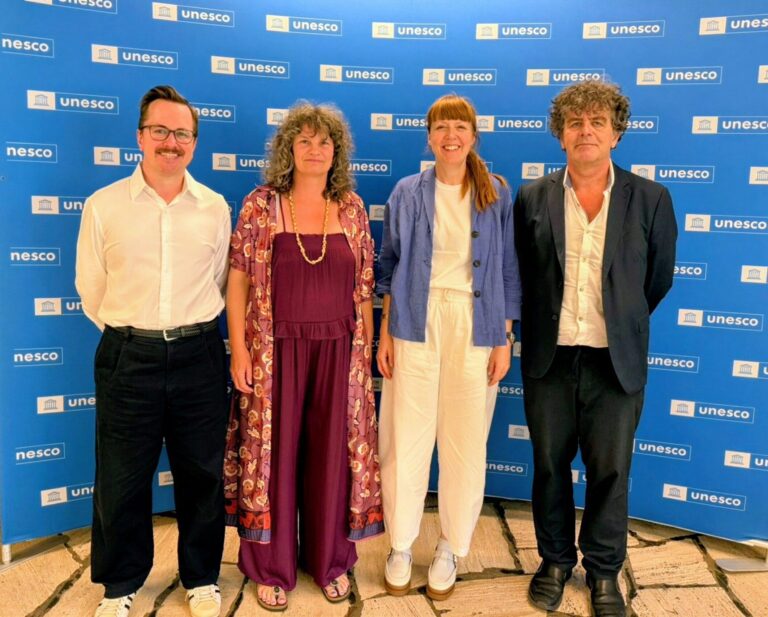
Launch of FLAME at the 20th Session of the Intergovernmental Committee
The European Centre for the Safeguarding of Living Heritage – FLAME – was presented to the international community on the occasion of the 20th session of the Intergovernmental Committee for the Safeguarding of the Intangible Cultural Heritage in New Delhi, India (20COM).
Introducing FLAME to the international audience in the context of one of the 2003 Convention’s central governance moments, this launch marks an important milestone in the development of the Centre and its positioning within the ecosystem of this Convention.
A dedicated side event was organized by the Flemish government focusing specifically on sharing the Centre’s development. This provided an opportunity to present the FLAMECentre’s mandate, guiding principles, current activities and future ambitions, as well as to engage in dialogue with a wide range of stakeholders.


Presenting FLAME in a space dedicated to inclusion

FLAME also participated into the 2025 Annual Symposium of the ICH NGO Forum, dedicated this year to the theme of inclusion, the ICH NGO Forum Symposium, held on the eve of the Committee meeting, offered a particularly relevant setting for this early public activity of FLAME. With ‘inclusion’ as its central theme, the symposium brought together accredited NGOs, practitioners, researchers, institutional representatives and other actors engaged in safeguarding living heritage.
Within this context, FLAME highlighted how it will support the implementation of the 2003 Convention through approaches that place participation, diversity and equitable access at the centre of safeguarding processes. FLAME’s presentation identified inclusion not as an abstract principle, but as a practical and structural concern, shaping the way safeguarding actions are designed, implemented and assessed across different institutional and social contexts.
Special attention was given to the role of NGOs within this framework. FLAME emphasised its intention to work closely with accredited NGOs and other civil society actors, recognising their experience, proximity to heritage communities and long-standing engagement with inclusive safeguarding practices. The Centre aims to provide spaces for exchange, cooperation and visibility for NGOs and civil society initiatives, and to integrate their perspectives into regional reflection, capacity-building activities and pilot projects.
A dedicated side event to present the Centre in detail
A dedicated side event organised during 20COM allowed for a more in-depth presentation of FLAME. This session focused on the Centre’s overall functioning, its strategic orientation and the activities already underway, while also outlining the next steps in its institutional development.
Participants were introduced to FLAME as a European platform for coordination, knowledge exchange and capacity-building, anchored in the European context but open to interregional and international cooperation. The Centre’s role was presented as complementary to that of States Parties, communities and existing institutions, with the objective of strengthening connections between actors, supporting experimentation and furthering coherent and effective implementation of the Convention.
The side event also provided an opportunity to explain the Centre’s two cross-cutting themes, inclusion and impact, and how they guide all areas of work.
Ongoing activities and operational foundations
During the presentations, FLAME shared concrete examples of activities that have already been carried out or are currently underway. These include involvement in several European cooperation projects addressing living heritage in relation to sustainable development, social inclusion, well-being and mental health.
Particular attention was given also to the recent capacity-building activities developed in Finland, focusing on strengthening skills related to safeguarding practices and participatory methodologies. These activities were presented as part of a broader approach to learning and exchange, grounded in practical experience and responsive to the needs of practitioners and institutions.
The Centre also highlighted its ongoing engagement with regional and international networks, its participation in professional and policy oriented discussions, and its contribution to spaces for dialogue around the implementation of the 2003 Convention. These activities form the operational basis on which FLAME continues to build its programme.

Towards a Category 2 Centre under the auspices of UNESCO
An important dimension of the presentations during the side event concerned the ongoing process to establish FLAME as a Category 2 Centre under the auspices of UNESCO. This upcoming candidature reflects a long-term institutional aspiration to reinforce regional cooperation and to contribute more structurally to the implementation of the 2003 Convention.
During the session, the distinction was clearly articulated between the European Centre as it currently operates and the future ambition to act as a Category 2 Centre, which is subject to a formal designation process by UNESCO’s governing bodies. Participants were informed about the objectives of this process, the governance and accountability requirements involved, and the importance of aligning the Centre’s mandate with UNESCO’s strategic frameworks, including the Programme and Budget (C/5) and the Medium-Term Strategy (C/4).
The presentation also emphasised that the candidature is being developed in dialogue with a broad range of stakeholders, including Member States, accredited NGOs, expert organisations and regional networks. This consultative approach aims to ensure that the future Category 2 Centre responds to identified needs, complements existing mechanisms, and remains firmly grounded in the principles of the Convention. The exchange with participants highlighted strong interest in the initiative, as well as the relevance of a regional centre focused on inclusion and impact.
 FLAME team presenting at the ICH NGO Forum preceding the opening of the 20th session of the Intergovernmental Committee 2025 in New Delhi. ©UNESCO/Paras Mendiratta
 Volunteer at the side event ‘Update on the development of FLAME, The European Centre for the Safeguarding of Living Heritage’. Picture by Jorijn Neyrinck.
 side event ‘Update on the development of FLAME, The European Centre for the Safeguarding of Living Heritage’.
 FLAME team presenting durant the side event dedicated: ‘Update on the development of FLAME, The European Centre for the Safeguarding of Living Heritage’.
An open invitation to collaborate
FLAME is conceived as an open and collaborative platform, and its development relies on dialogue, partnerships and shared initiatives. The Centre wishes to work with organisations and institutions that share that interest in inclusive, participatory and knowledge-sharing approaches. NGOs, public institutions, professional networks, researchers and practitioners are encouraged to get in touch to explore forms of cooperation tailored to their contexts and priorities.
Whether to explore joint projects, contribute expertise, participate in activities or engage in regional and international exchanges, FLAME welcomes collaboration and dialogue. Those interested are invited to contact the Centre by email and to follow its future activities through the website.
More info: