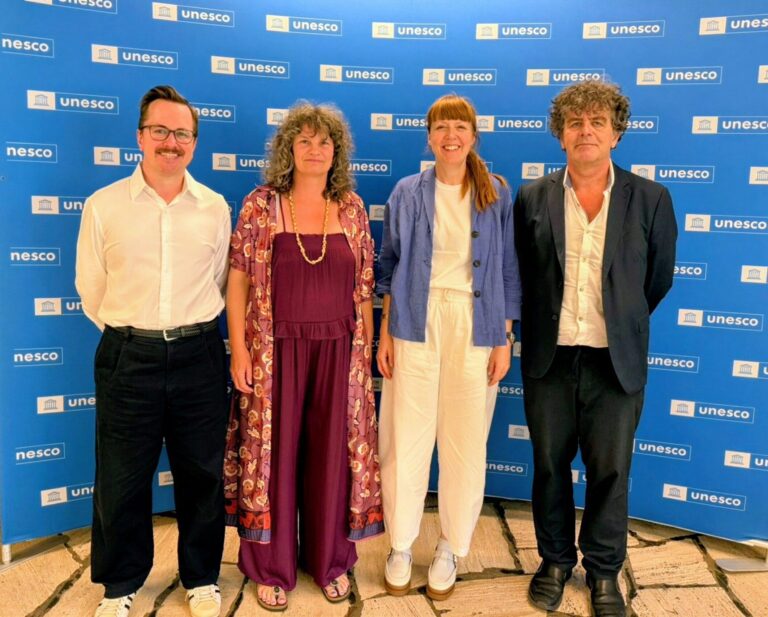
FLAME’s candidature as a Category 2 Centre submitted to UNESCO
There we go! The official submission of FLAME’s candidature to become a UNESCO Category 2 Centre is now complete. This marks a major step forward in a shared ambition: building a strong, collaborative platform for the inclusive and impactful safeguarding of living heritage in Europe and beyond.

On Friday 27 March 2026 a delegation of Flemish and Belgian colleagues travelled to UNESCO Headquarters in Paris to formally submit the dossier. It was handed over to Ms. Fumiko Ohinata, Secretary of the 2003 Convention for the Safeguarding of the Intangible Cultural Heritage.


A collective effort, built over time
This submission is the result of several years of dialogue, consultation and collaboration.
From the very beginning, FLAME has been shaped as a collaborative initiative. States Parties, accredited NGOs, researchers, practitioners, facilitators and international partners all contributed to defining its role and direction. Together, we identified key needs, mapped existing initiatives and ensured that FLAME complements – rather than duplicates – ongoing efforts around the 2003 Convention.
This process also laid the foundations for FLAME’s strategic focus: strengthening inclusive participation, building capacities, fostering cooperation and the societal impact of living heritage. These priorities are at the heart of the Centre’s 2026-2031 strategic plan.
Strong support across Europe
FLAME’s candidature has received broad and enthusiastic support from across the living heritage field.
Key networks such as the European Network of Focal Points (ENFP), along with many other partners involved in implementing the 2003 Convention, have expressed their enthusiasm and commitment to the initiative. This strong backing reflects both a need and a momentum for a dedicated European centre that connects actors, strengthens collaboration and helps scale up impact.
What FLAME sets out to do
FLAME is designed as a collaborative hub, creating a platform for knowledge development, dialogue and cooperation.
Its programme focuses on:
strengthening community participation and inclusivity, especially for underrepresented groups
building capacity and policy support for effective implementation of the Convention
fostering European and international networks and peer learning
developing impact-driven approaches, showing how living heritage contributes to wellbeing, resilience and sustainable development
Concrete actions already in development include pilot projects on living heritage in urban contexts, heritage in situations of displacement, and the role of heritage in wellbeing and resilience. FLAME will develop tools, training and research to better understand and strengthen the impact of safeguarding efforts.
The road ahead
This submission is a milestone and marks the start of the formal UNESCO designation process. The dossier will now be reviewed by the Secretariat and subsequently examined by UNESCO’s governing bodies, including the Executive Board.
In parallel, FLAME continues to move forward. We are strengthening partnerships, launching collaborations and preparing future programmes that respond to today’s societal challenges – from sustainability and urbanisation to crises and ethical questions.
Throughout this journey, FLAME remains guided by two core ambitions: advancing inclusivity and driving impact in the safeguarding of living heritage. By doing so, it aims to contribute meaningfully to the implementation and visibility of the 2003 Convention both in Europe and worldwide.